
Market research survey
Market research surveys with the right people answering
Most market research goes wrong before the first question: it asks the wrong people. Here is how to define who should answer, buy a verified sample, and write questions that do not lead them.
In short
A market research survey collects opinions and behaviour from a defined group of potential buyers — not just your existing customers — to size demand, test concepts, names or prices, and compare you with competitors. The sample matters as much as the questions: screen for the people who actually buy in your category.
Start with who should answer
Your customer list is the easiest sample and the most biased one for market research: it contains people who already chose you. For demand, pricing and brand questions you need people who buy in the category, including those who buy from competitors.
Write the definition in one sentence — 'US adults aged 25–54 who bought coffee beans online in the last three months' — then turn it into targeting (age, region) and a screener question at the start of the survey for the behaviour.
How many responses you need
For a single percentage, the margin of error at 95% confidence is roughly ±10 points with 100 responses, ±5 with about 385 and ±3 with about 1,070. If you plan to compare groups — under 35 versus over 35, say — you need that sample size in each group, not in total.
| Responses | Margin of error |
|---|---|
| 100 | ±9.8 points |
| 200 | ±6.9 points |
| 385 | ±5.0 points |
| 600 | ±4.0 points |
| 1,067 | ±3.0 points |
Questions that do not lead
Respondents try to be helpful, which makes leading questions dangerous: they tell you what you hoped to hear.
- Describe concepts in plain language, without adjectives like 'innovative' or 'premium'.
- Ask about past behaviour ('In the last three months…') before future intentions.
- Randomise the order of brands, concepts and answer options.
- Include 'None of these' and 'Not sure' so nobody is forced into an answer.
- Treat stated purchase intent cautiously: people say 'definitely would buy' more often than they do.
Common market research studies
Each of these has a ready-made template written for purchased respondents.
| Study | Answers the question |
|---|---|
| Concept test | Is this idea relevant, different and believable — and would people buy it? |
| Van Westendorp pricing | What price range feels acceptable, and where does it become too expensive? |
| Brand awareness | How many people know us unaided and aided, versus competitors? |
| Name or logo test | Which option is easiest to remember and fits best? |
| Ad or message test | Which creative or claim is clearest and most believable? |
| Segmentation | What groups exist in the market, and what does each need? |
Quality control you can audit
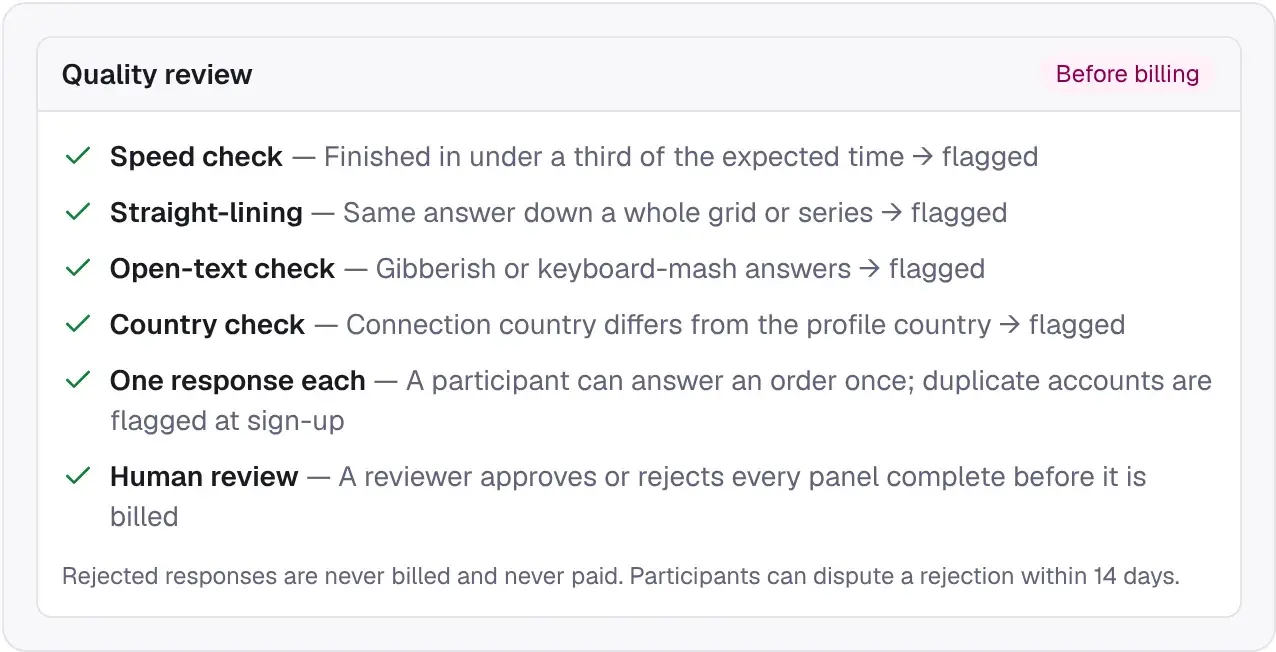
Purchased samples need checks. Every SurveyHood complete is screened for speeding, straight-lining, gibberish open answers and country mismatches, and reviewed before it is billed; rejected responses are never charged. Each response is labelled with its source — our own panel or a named partner panel — and its country.
Example questions and why they work
| Question | Type | Why ask it |
|---|---|---|
| In the last three months, have you bought [category]? | Screener | Removes people outside the market before they dilute results. |
| How interesting is this idea to you? | Single choice | The first gate in a concept test. |
| How likely would you be to buy it if it were available today? | 5-point intent | Purchase intent; discount the top box when forecasting. |
| What would you expect to pay for it? | Price bands | Anchors willingness to pay without a leading number. |
| What would stop you from buying? | Multiple choice | Barriers you can address in product or messaging. |
How to run a market research survey
About 45 minutes
Write the decision and the audience
State the decision the research informs and define the target buyer in one sentence.
Choose a study template
Pick concept test, pricing, brand awareness, naming or segmentation and edit the placeholders.
Add a screener
Add one or two questions at the start that screen out people outside your target.
Get a quote and order respondents
Choose the country, audience and number of completes; see the price before you pay.
Soft launch
Field the first 10% and check timings and screen-out rates before the rest goes out.
Analyse by segment
Use cross-tabs with significance tests to compare groups, and report sample sizes.
How teams use it
Illustrative examples of how the templates are typically used, not customer case studies.
A specialty food start-up
- Goal
- Choose between three brand names before launch.
- Set-up
- The name testing template with 300 purchased US respondents who buy specialty foods, names shown in random order.
- What they learned
- Two names scored similarly on appeal, but one was far easier to remember and spell, which decided it.
A home-fitness equipment brand
- Goal
- Set a launch price for a new product.
- Set-up
- The Van Westendorp template with 400 US respondents who exercise at home at least weekly.
- What they learned
- The acceptable price range sat below the planned price, so the team tested a smaller bundle at a lower entry price.
Templates to start from
- Market research: new product ideaTest demand, price expectations and objections for a product idea before you build it.6 questions · ~3 min
- Concept testingUniqueness, relevance, believability, purchase intent and objections for a product concept shown as text or image.6 questions · ~3 min
- Price sensitivity (Van Westendorp)The four Van Westendorp questions that give you an acceptable price range and an optimal price point.5 questions · ~2 min
- Brand awareness surveyUnaided and aided awareness, consideration and preference against competitors, written for repeat tracking.7 questions · ~3 min
- Brand name testingCompare candidate names on memorability, fit and appeal with the people you want to reach.6 questions · ~3 min
- Competitive analysis surveyWhich alternatives buyers considered, what they chose and why, and how you compare on the attributes that decided it.5 questions · ~4 min
Frequently asked questions
Where do the respondents come from?
From the SurveyHood panel — people who registered with us, verified their email and country and completed a profile — and, if you allow it, licensed partner panels for audiences we cannot fill ourselves. Every response is labelled with its source.
Can I target specific audiences?
Yes: age, gender, region and profile attributes such as employment, household and shopping behaviour. Narrower audiences cost more per complete and take longer to fill; the quote shows both before you pay.
How fast are results?
General-population US studies often fill within a few days; niche audiences take longer. The quote includes an estimated delivery time.
Can I use my own customer list too?
Yes. Send the same survey to your list and to purchased respondents; results stay separated by source so you can compare them.
What makes a market research survey biased?
Usually the sample (surveying only your fans), leading wording, fixed answer orders and missing 'none' options. The templates are written to avoid these.
Start free in under a minute
No credit card. Free plan includes 3 surveys and 100 responses a month.