
NPS survey
Net Promoter Score surveys, explained and ready to send
NPS is one question with two follow-ups. The hard part is not asking it — it is asking the right people at the right interval and turning the answers into decisions.
In short
A Net Promoter Score survey asks 'How likely are you to recommend us to a friend or colleague?' on a 0–10 scale. People who answer 9–10 are promoters, 7–8 passives and 0–6 detractors. NPS is the percentage of promoters minus the percentage of detractors, so it ranges from −100 to +100.
How NPS is calculated
Take the share of respondents who answered 9 or 10 and subtract the share who answered 0 to 6. Passives (7 and 8) count toward the total but not the score. With 200 responses — 110 promoters, 50 passives and 40 detractors — NPS is 55% − 20% = +35.
Because NPS is a difference between two percentages, it moves more than a simple average when opinion shifts, and small samples make it jumpy. With 100 responses, the margin of error on an NPS is typically around ±15 points; with 400 it is closer to ±8. Look at the trend over several waves before you celebrate or panic. The NPS calculator on this site shows the margin of error for your numbers.
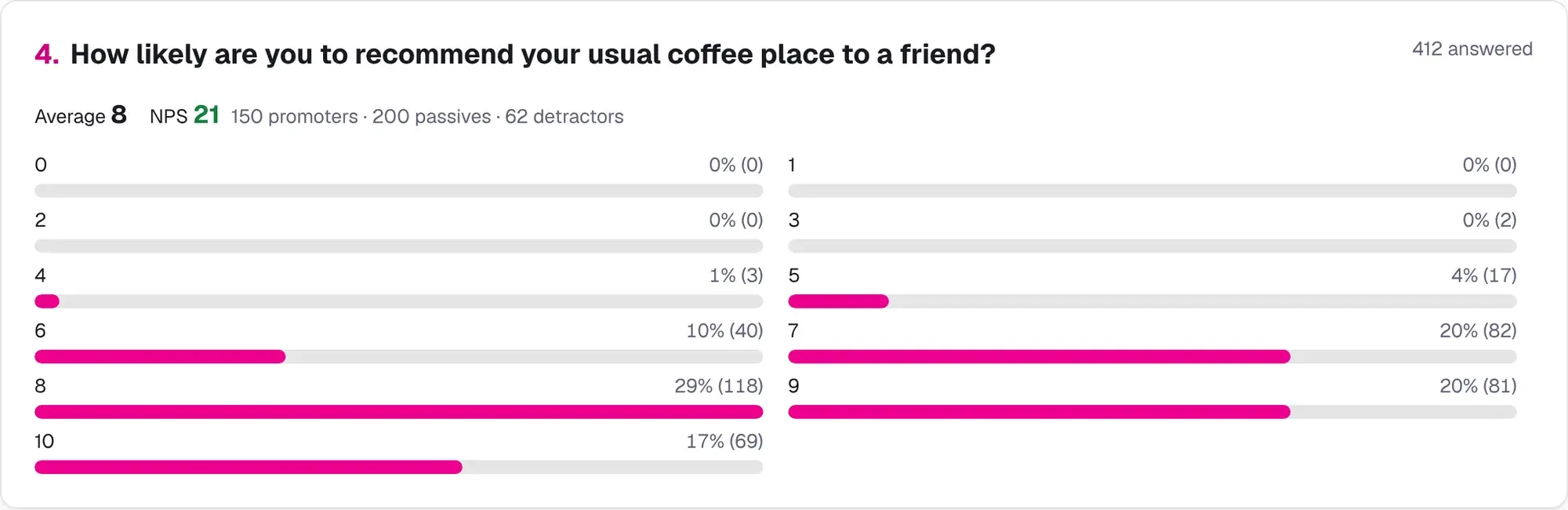
The two follow-up questions that make NPS useful
A score on its own tells you how you are doing, not why. Always follow it with an open question — 'What is the main reason for your score?' — and read the detractors' answers first. Then ask permission to follow up, so you can close the loop with the people who are unhappy.
Resist adding more. NPS surveys are designed to take under a minute; every extra question lowers the response rate and makes the survey feel like a chore to your most loyal customers.
Relationship NPS vs transactional NPS
Relationship NPS goes to your whole customer base on a schedule — once or twice a year — and measures overall loyalty. Transactional NPS goes out after a specific touchpoint such as onboarding or a support case and tells you which moments create promoters or detractors.
Run both if you can, but do not mix them in one number. A transactional NPS measured right after a successful support call will usually be higher than the relationship score, and averaging them hides both signals.
What is a good NPS?
Anything above zero means you have more promoters than detractors. Beyond that, published 'industry benchmarks' are rarely comparable: they use different sampling, timing and question wording. The benchmark that matters is your own previous wave, measured the same way.
If you want an external comparison, buy a sample of category buyers who are not your customers and ask them about the brands they use, including yours. That gives a like-for-like comparison you control.
Example questions and why they work
| Question | Type | Why ask it |
|---|---|---|
| How likely are you to recommend us to a friend or colleague? | NPS 0–10 | The standard question. Do not change the wording or the scale. |
| What is the main reason for your score? | Open text | Explains the number. Code answers into themes. |
| May we follow up with you about your answer? | Yes / No | Lets you close the loop with detractors. |
How to run an NPS survey
About 10 minutes
Choose relationship or transactional
Decide whether you are measuring overall loyalty on a schedule or loyalty after a specific touchpoint.
Use the three-question template
Open the NPS template: the 0–10 question, the reason and permission to follow up.
Pick who receives it
Send to active customers with at least a month of experience, and no more than once a quarter per person.
Send and wait a week
Most responses arrive in the first 48 hours; leave it open for a week and send one reminder.
Read detractors first
Filter to 0–6, read the reasons and contact the people who agreed to a follow-up.
Compare with the last wave
Report the score with its sample size and compare it with your previous wave, not with an industry average.
How teams use it
Illustrative examples of how the templates are typically used, not customer case studies.
A subscription meal-kit company
- Goal
- Find out why churn rose after a price change.
- Set-up
- Relationship NPS to all active subscribers plus a cancellation survey in the cancel flow.
- What they learned
- Detractors overwhelmingly cited portion size, not price; the cancellation reasons agreed. The team tested a larger portion option before touching the price again.
A B2B software vendor
- Goal
- Know which accounts were at risk before renewal.
- Set-up
- Transactional NPS at day 30 and relationship NPS twice a year, with the account name passed as a hidden variable.
- What they learned
- Accounts with two or more detractors were flagged to customer success sixty days before renewal.
Templates to start from
- Net Promoter Score (NPS)The standard 0–10 loyalty question plus the two follow-ups that make it actionable: the reason, and permission to follow up.3 questions · ~1 min
- Transactional NPSNPS tied to a specific moment (delivery, onboarding, support) so you can see which touchpoints create promoters and detractors.3 questions · ~1 min
- Customer loyalty and advocacyFind your advocates: repeat intent, referrals already made, review willingness and what customers say about you to others.5 questions · ~2 min
- Cancellation surveyFour questions at the moment of cancellation: the reason, what would have changed it, where they are going, and whether they would return.4 questions · ~1 min
- Voice of the customerA relationship survey across product, service, value and loyalty, with a priority question so you know what to fix first.7 questions · ~5 min
Frequently asked questions
Who invented the Net Promoter Score?
NPS was introduced by Fred Reichheld with Bain & Company and Satmetrix in 2003. Net Promoter, NPS and Net Promoter Score are registered trademarks of Bain & Company, Inc., Satmetrix Systems, Inc. and Fred Reichheld.
Why does NPS go from −100 to +100?
Because it is the percentage of promoters minus the percentage of detractors. If everyone is a detractor the score is −100; if everyone is a promoter it is +100.
How often should I run an NPS survey?
Relationship NPS once or twice a year; transactional NPS after key moments. Avoid surveying the same person more than once a quarter.
How many responses do I need for a reliable NPS?
NPS is noisier than an average. With about 100 responses the margin of error is roughly ±15 points; with 400 it is around ±8. Report the sample size alongside every score.
Can I add more questions to an NPS survey?
You can, but keep it under a minute. The value of NPS comes from high response rates and a consistent question over time.
Start free in under a minute
No credit card. Free plan includes 3 surveys and 100 responses a month.