
Customer satisfaction survey
Customer satisfaction surveys that tell you what to fix
A good CSAT survey is short, sent at the right moment, and ends with one question that explains the score. Here is how to write one, send it and act on it — with a free template that does it for you.
In short
A customer satisfaction (CSAT) survey asks customers to rate a specific experience — usually on a 1–5 scale from very dissatisfied to very satisfied — shortly after it happens. Your CSAT score is the share of people who answer 4 or 5. Pair the rating with one open 'why' question and you know both how you are doing and what to change.
What a CSAT survey measures (and what it does not)
CSAT measures how a customer felt about one interaction: a purchase, a delivery, a support ticket, an appointment. It is a short-term, transactional signal. That is its strength — it tells you which moments in the customer journey are working — and its limit: a high CSAT on every ticket does not guarantee the customer will renew.
For the relationship as a whole, use a Net Promoter Score survey once or twice a year. For service interactions specifically, a Customer Effort Score often predicts repeat business better than satisfaction does. Most teams run CSAT after key moments and NPS on a schedule, and read them together.
| Metric | Question | Scale | Best for |
|---|---|---|---|
| CSAT | How satisfied are you with …? | 1–5 | A specific interaction, right after it happens |
| NPS | How likely are you to recommend us …? | 0–10 | The overall relationship, measured periodically |
| CES | How easy was it to …? | 1–5 or 1–7 | Support and self-service tasks |
How to calculate your CSAT score
Count the respondents who chose 4 (satisfied) or 5 (very satisfied), divide by everyone who answered the question, and multiply by 100. If 172 of 200 customers answer 4 or 5, your CSAT is 86%.
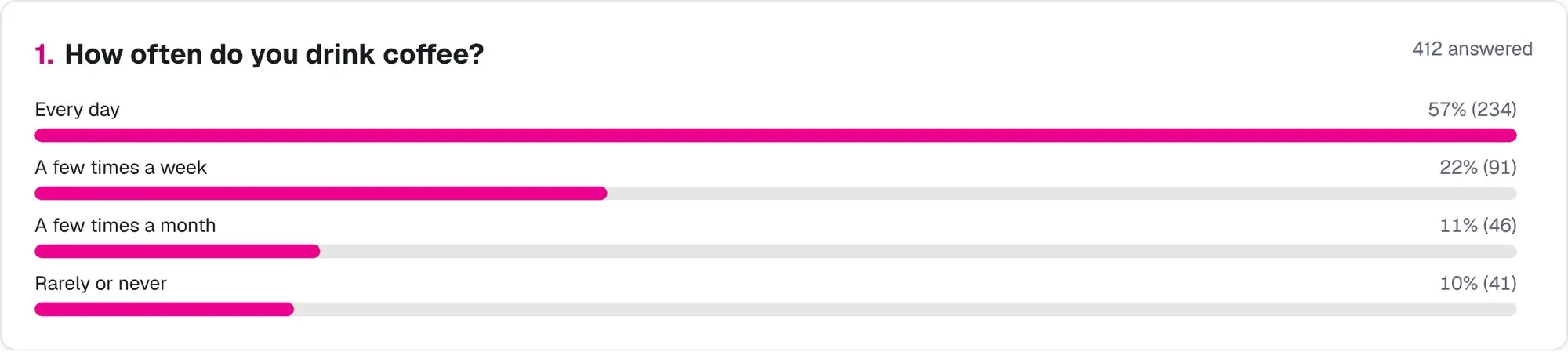
Report this 'top-two-box' share rather than the average rating. An average of 4.1 hides whether you have a few angry customers or many lukewarm ones; the share of satisfied customers does not. SurveyHood shows the full distribution for every rating question, so you can see both.
When to send a customer satisfaction survey
Timing changes the answer. Too early and the customer has not experienced what you are asking about; too late and they remember a vague impression instead of the specifics you can fix.
- After a support ticket: as soon as it is closed, while the conversation is fresh.
- After an online order: three to five days after delivery, so they have used the product.
- After an in-person visit: the same day, from a QR code on the receipt or table.
- After onboarding: around day 30, once they have tried to get value on their own.
- Never more than once a month to the same person, whatever triggers fire.
Turning scores into changes
Start with the open answers from people who scored 1–3. They are the cheapest research you will ever get: specific, recent, and written by people with a reason to tell you. Tag each answer with a theme (delivery time, price, staff, product quality) and count the themes; the biggest one is your next fix.
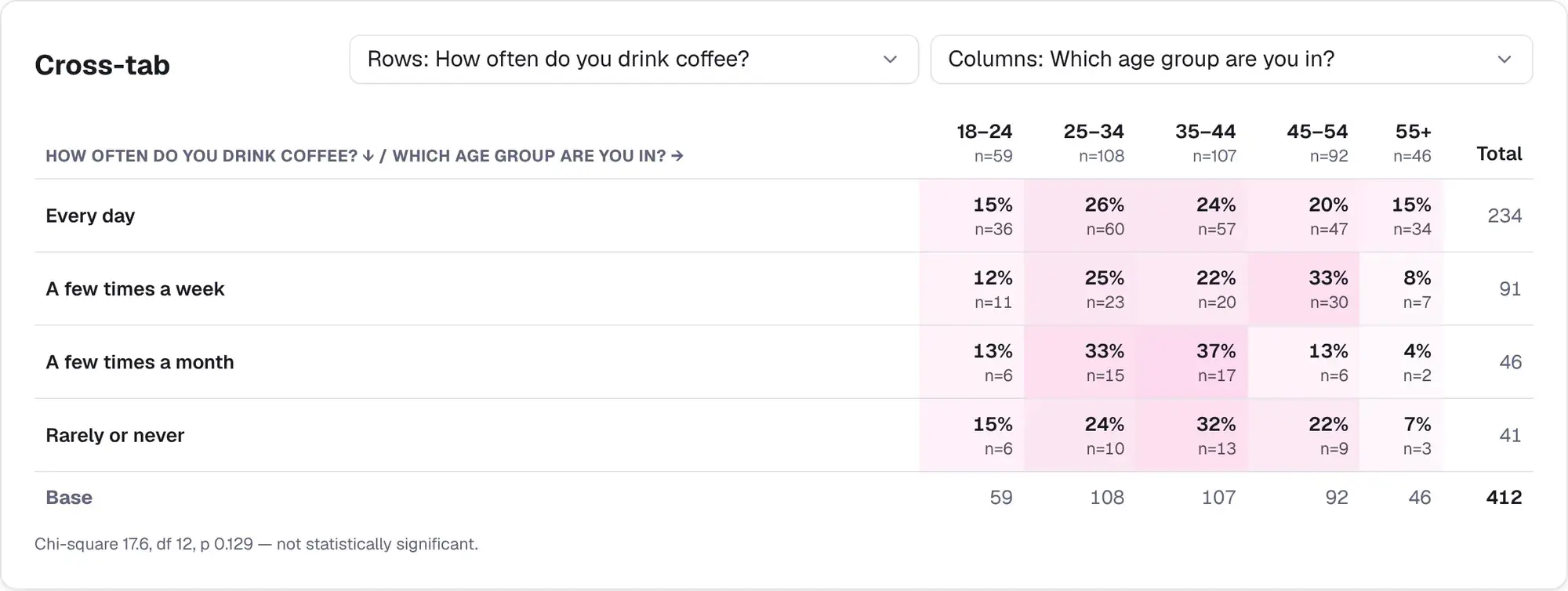
Then segment. A CSAT of 82% overall might be 91% for repeat customers and 68% for first-time buyers, which is a very different problem. Use filters and cross-tabs to compare by store, channel, product or customer type before deciding anything.
Close the loop. When a customer leaves a low score and agrees to be contacted, reply within a day. Customers who see a complaint handled well often end up more loyal than those who never had a problem.
Five mistakes that make CSAT data useless
Most unreliable satisfaction data comes from a handful of avoidable design choices.
- Asking about two things at once ('How satisfied are you with our price and quality?').
- Leading wording ('How much did you enjoy our award-winning service?').
- Unbalanced scales that run from 'Good' to 'Excellent'.
- Only surveying customers who already left a review, which skews positive.
- Twenty questions where five would do; every extra question costs completions.
Example questions and why they work
| Question | Type | Why ask it |
|---|---|---|
| Overall, how satisfied are you with your recent experience? | Rating 1–5 | The headline CSAT question. Keep the wording identical over time so scores stay comparable. |
| Did we resolve what you needed on the first try? | Single choice | First-contact resolution is the strongest driver of service satisfaction. |
| How easy was it to get what you needed? | Rating 1–5 | Captures effort, which satisfaction alone can miss. |
| Which of these describe your experience? | Multiple choice | Quick, quantifiable reasons (fast, friendly, confusing, slow) you can track. |
| What is the one thing we could do better? | Open text | The answer that tells you what to change. Ask it last. |
How to run a customer satisfaction survey
About 15 minutes
Pick the moment
Choose one interaction to measure — a closed ticket, a delivery or a visit — and decide when the survey goes out.
Start from the CSAT template
Open the free template: one satisfaction rating, two driver questions and one open question. Remove anything you will not act on.
Add your branding
Add your logo and colours so customers recognise the email or QR code.
Send it
Share the link in your order confirmation, help-desk signature or receipt, or upload a CSV or Excel list of customers for one-time invitation links.
Read the low scores first
Open the results, filter to scores of 1–3 and read their open answers. Tag them by theme.
Act and repeat
Fix the largest theme, then compare next month's CSAT with this month's.
How teams use it
Illustrative examples of how the templates are typically used, not customer case studies.
A two-location bakery
- Goal
- Find out why weekend reviews were weaker than weekday ones.
- Set-up
- A QR code on every receipt linked to the CSAT template with one extra question: which location did you visit?
- What they learned
- A cross-tab by location and day showed the Saturday queue at one shop drove most low scores; adding a second till on Saturdays was the fix to test.
A software company's support team
- Goal
- Measure support quality per channel.
- Set-up
- The customer service template sent automatically when a ticket closes, with the channel captured as a hidden variable from the link.
- What they learned
- Chat scored higher than email on speed but lower on resolution, so the team added a 'still need help?' follow-up for chat tickets.
Templates to start from
- Customer satisfaction (CSAT)A three-minute check on how a recent purchase or support interaction went, with one open question that tells you why.6 questions · ~3 min
- Customer service feedbackPost-ticket survey separating the agent's behaviour from the outcome, so coaching and process fixes go to the right place.6 questions · ~2 min
- Post-purchase surveyCheckout, delivery and first impressions of the product in one short survey sent a few days after the order arrives.7 questions · ~3 min
- Customer effort score (CES)Measure how hard customers had to work to get an issue resolved; low effort predicts repeat business better than satisfaction.4 questions · ~1 min
- Live chat feedbackTwo-question rating shown as a chat closes, with an optional comment. Built to be answered in ten seconds.3 questions · ~1 min
- Restaurant dining feedbackFood, service, ambience, value and wait time after a visit, via a QR code on the bill. Under a minute to answer.4 questions · ~1 min
Frequently asked questions
What is a good CSAT score?
It depends on the industry and the moment you measure, so compare against your own history rather than published benchmarks, which use different scales and methods. A rising top-two-box share over three or more periods matters more than any single number.
How many questions should a customer satisfaction survey have?
Five to eight. One satisfaction rating, two or three drivers and one open question are enough to act on. Each additional question lowers the share of people who finish.
Should a CSAT survey use a 5-point or 10-point scale?
Five points is the convention for CSAT and is easiest to answer on a phone. Use the same scale every time so results stay comparable.
How many responses do I need?
For a trend you can act on, around 30 responses per period is a practical minimum; to compare groups, aim for 30 per group. For a margin of error of ±5% at 95% confidence on a large customer base you need about 385. Our sample size calculator does the maths for your numbers.
Can I send CSAT surveys automatically?
Yes. Share a permanent link in automated emails, embed the survey on a confirmation page, or use the API and webhooks to send it from your own system when an order or ticket closes.
Is the customer satisfaction survey template free?
Yes. The template and the builder are included on the Free plan with 100 responses a month. Paid plans add logic, exports, cross-tabs and larger allowances.
Start free in under a minute
No credit card. Free plan includes 3 surveys and 100 responses a month.